Developed under the Recreation of European mulberry heritage
Catalogue of
Mulberry Varieties
Documenting the Morphological Diversity of Traditional Mulberry Varieties
from Germplasm Collections of Aracne Countries



Description of the project
ABOUT THE PROJECT
The ARACNE project focuses on the cultural heritage of European silk production and its preservation, protection, and valorisation; it aims to reinvigorate traditional skills through the adaptive reuse of common cultural and artistic legacies and to shape a silk-linked European cultural identity. The production, past, and present development of the silk sector can again serve as a common basis for a future European Silk Route, intended as a cultural itinerary across Europe. To create a wide and well-connected network that, starting from the historical path followed by Marco Polo in his travels to the East, even includes the routes of silk production and commercialisation in Europe in the following centuries.
Introductory notes
NOTES
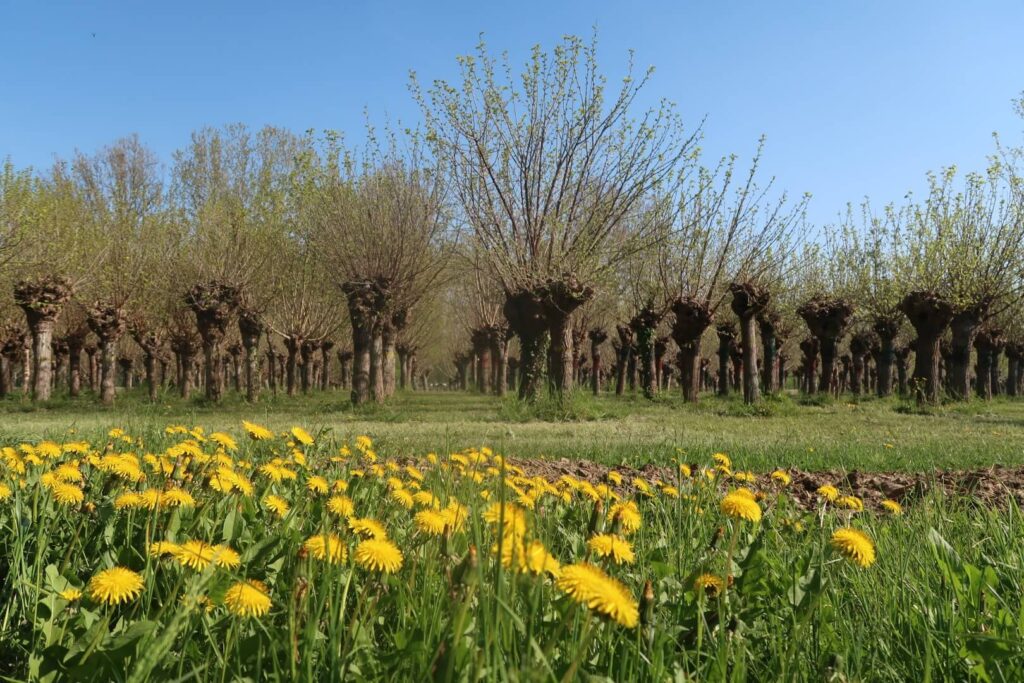
The most significant mulberry collections among the ARACNE partner countries are maintained at CREA Padua, Italy (Consiglio per la Ricerca in Agricoltura e l'Analisi dell'Economia Agraria, Padova), SCS Vratsa, Bulgaria (Nauchen Tsentar Po Bubarstvo Vratsa), UM, Slovenia (University of Maribor, Faculty of Agriculture and Life Sciences), and IMIDA, Spain (Instituto Murciano de Investigacion y Desarrollo Agrario y Medioambiental, Murcia).
The systematic evaluation of these collections—through monitoring vegetative and reproductive traits using standard mulberry descriptors, complemented by genetic analyses—is essential for supporting selection and propagation programmes related to sericulture, landscape planning, and sustainable use of mulberry resources. The growth and yield of mulberry plants are significantly influenced by environmental conditions. Therefore, systematic documentation of morphological and phenological traits over the three-year duration of the ARACNE project plays a critical role in maximising the use of these resources and selecting high-yielding morphotypes. This documentation equips rearers/farmers with the detailed information needed for decision-making.
Sharing germplasm information is vital not only for countries practising sericulture but also for those using mulberry leaves as animal fodder, mulberry fruits as food, and other by-products for various purposes. Furthermore, characterising germplasm is crucial to identifying individual genotypes, understanding variability among accessions, and facilitating comparisons for further research and practical use. This process involves systematically documenting highly heritable traits, enabling the identification of diverse mulberry germplasm and supporting the development of a robust database for research and moriculture initiatives.
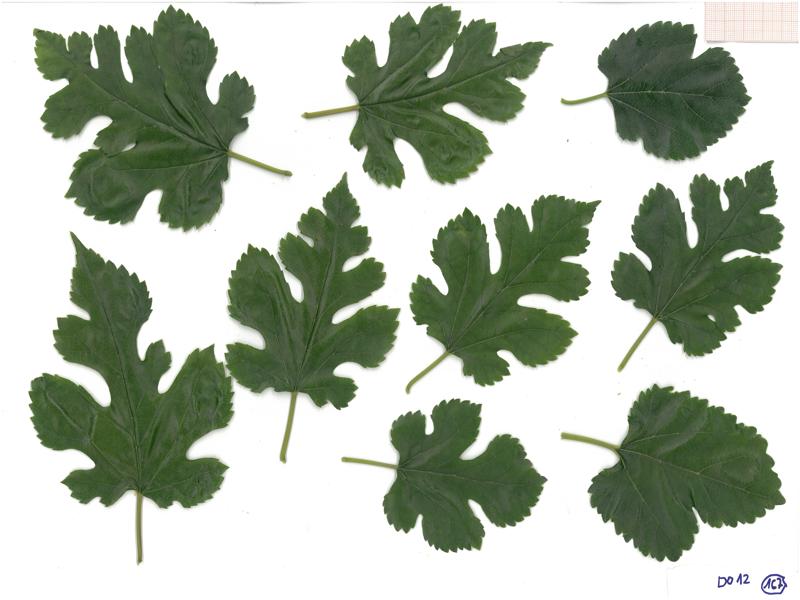
The Mulberry Varieties Catalogue presents mulberry genotypes maintained in the collections of CREA, Vratsa, IMIDA, and UM. The varieties were systematically monitored using UPOV Mulberry descriptors, basically modified as described in Guidance model to collect mulberry samples, which covered trunk, shoot, bud, inflorescence, infructescence, and phenological traits, as well as growth and yield attributes. Observations were conducted over the period from 2023 to 2025. These results will be integrated with genetic analyses to deepen our understanding of the genetic relationships within the available germplasm, recognising it as a valuable component of the European sericultural heritage.
PARTNERS INVOLVED
Partners involved in the mulberry varieties’ catalogue
CREA Padua, Italy - Consiglio per la Ricerca in Agricoltura e l'Analisi dell'Economia Agraria
The current collection consists of 68 varieties. 50 varieties belonging to the ingroup M. alba s.l., 14 varieties assigned to M. indica s.l., 3 varieties M. rubra cf. or hybrids between M. alba and M. rubra. M. nigra is represented by one genotype. The varieties originate from Italy, France, Spain, China, Japan, and Brazil.
SCS Vratsa, Bulgaria - Nauchen Tsentar Po Bubarstvo Vratsa
The germplasm maintains 180 accessions. 96 accessions are selections of the SCS Vratsa breeding programme. Fourteen accessions are categorised as M. alba s.l., 80 genotypes are regarded as hybrids between M. alba and M. indica with no clearly defined genetic background (Morus sp.), and two varieties are categorised as M. indica.
University of Maribor, Faculty of Agriculture and Life Sciences (UM FKBV)
The collection is divided into 3 sections. The 1. section comprises sericultural varieties of different origin (8 varieties, 272 trees), the 2. section is represented by old local Slovenian (80 genotypes) and Hungarian varieties (127 genotypes), the 3. section is represented by varieties for fruit production (20).
IMIDA Murcia, Spain - Instituto Murciano de Investigacion y Desarrollo Agrario y Medioambiental
The collection is represented by 35 varieties. Of these, 31 varieties belong to M. alba s.l. The ingroup M. indica s.l. is represented by three varieties of ‘Kokusou’, namely Kokusou 20, 21 and 27. In addition, one local M. nigra is part of the collection.