
Origin, systematics, key morphological traits, and conservation of mulberry varieties in relation to sericulture
MULBERRY SYSTEMATICS
Mulberries (Morus spp., Moraceae) are deciduous trees with a long history of domestication and selection for sericulture. In Europe, the earliest mulberry species introduced was Morus nigra L., native to western and southwestern Iran. M. nigra thrived in the Near East and Europe at least since the Iron Age and Roman times, as documented by literary sources and archaeobotanical records. This predates the widespread establishment of M. alba L., which was introduced from East Asia into the Mediterranean Basin with the expansion of sericulture, probably between the ninth and twelfth centuries. Thereafter, M. alba was gradually promoted in late Byzantine era and expanded markedly from the sixteenth century onward, reaching its golden era of cultivation during the eighteenth and nineteenth centuries, when sericulture flourished across most European countries. The widely distributed “Filippine” variety, taxonomically treated as M. multicaulis (M. indica var. multicaulis) and historically reported as imported via the Philippines, entered the European cultivation in the early nineteenth century (often cited around 1825) and is commonly placed within the M. indica genetic background. Additional high-leaf-yielding varieties associated with the M. indica complex, frequently referenced under traditional (variety-level) names such as latifolia, kagayamae and bombycis, were introduced from Japan between the 1930s and 1950s. In recent decades, hybrids involving M. rubra of the American origin have also been introduced to Europe, primarily for fruit production but in some cases also considered for sericultural use.
From a sericultural perspective, the most important genetic background is concentrated in the white mulberry (Morus alba sensu lato) and the Indian mulberry ingroup (Morus indica sensu lato), which together underpin most traditional and modern high-leaf-yield varieties. These ingroups are taxonomically and genetically complex because mulberries exhibit pronounced phenotypic plasticity (notably leaf heterophylly), variable sex expressing systems (monoecious or dioecious, including variations among genotypes) and extensive cytogenetic diversity (ploidy ranging from predominantly diploid and triploid cytotypes in M. alba to docosaploidy in M. nigra). Moreover, frequent spontaneous hybridisation as well as targed genetic recombination through breeding programmes blurred boundaries among species and on lower taxonomical level. Historically, mulberries were often propagated generatively (by seeds), which increased genetic variation as well as within-region diversity. In warmer regions of Italy and the former Austro-Hungarian monarchy, grafting of high-performing genotypes has been more common since late 18th century.
Consequently, morpho-phenological traits alone are frequently insufficient for reliable cultivar identification, even when detailed morphological descriptors are applied. Moreover, this biological and taxonomic complexity directly affects how genetic resources should be conserved, how planting material is maintained and propagated, and how mulberry breeders and growers select genotypes suited to local climate and management conditions. In response, best practice increasingly combines standardised morphological cataloguing supported with molecular tools to resolve uncertainties at lower taxonomic level, identify synonyms, and support robust selection and conservation decisions.
A specific challenge for the taxonomic positioning of the mulberries presented in the ARACNE mulberry catalogue is that many varieties are recorded under traditional names and synonyms (syn.) that have been applied historically to taxa now treated under different accepted scientific names and taxonomical level. In addition, many modern sericultural varieties originate from simple or complex crosses (spontaneous and/or artificial breeding) among M. alba, M. indica and M. rubra. Accordingly, most varieties associated with M. alba and M. indica are treated as sensu lato (s.l.; “in the broad sense”), whereas putative M. rubra accessions are provisionally assigned as M. rubra confer (cf.). The qualifier “cf.” indicates that most diagnostic characters correspond to M. rubra, but some are ambiguous; identification is therefore provisional and expected to be resolved through comparison with reference material. The genetic relationships of the catalogued varieties are currently being analysed within the ARACNE project.

Morus alba L. (white mulberry): the global sericultural backbone
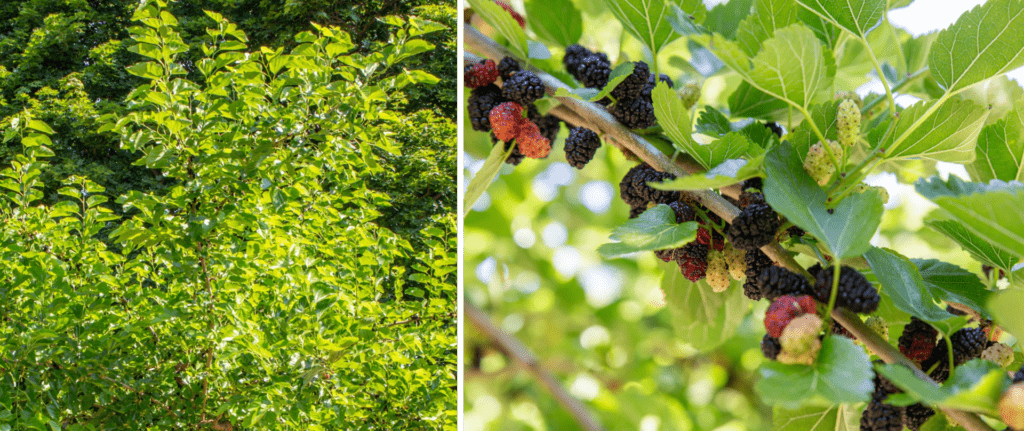
Origin and distribution. Morus alba is accepted as native to the Central China and has been disseminated widely through centuries of sericulture, becoming extensively cultivated and often naturalised across Europe and many other regions. This long history has generated a large pool of local varieties and named cultivars, including centuries-old trees that represent both cultural heritage and locally adapted genetic resources.
Key morphological traits relevant to sericulture. M. alba is typically a fast-growing small to medium-sized tree with highly variable leaves, that are commonly ovate to broadly ovate, predominated by retuse and truncate leaf base, obtuse and acute leaf apex, acuminate tip and crenate or serrate leaf margins. Heterophylly is common (lobed and unlobed leaves may occur on the same individual), with number of lobes influenced by genotype, tree age and vigour, pruning, and position within individual branch and within canopy. Buds are usually broadly to narrowly triangular and greyish to medium brown; current-year shoots are predominantly greyish to medium brown. Sexual expression varies (monoecious or dioecious), and inflorescences form male and/or female catkins, including polygamous expressions depending on genotype. Infructescences (soroses) show wide colour variation, ranging from yellowish-white to pink, dark red and black, with intermediate shades during ripening.
Conservation value and potential. Sericultural selection has historically favoured genotypes with high leaf biomass and suitable leaf texture, because leaf quantity and quality directly influence silkworm performance. Conserving M. alba diversity is therefore essential to sustaining sericulture under changing climates and management systems. Ex-situ field collections are essential for maintaining cultivars; however, long-term security increasingly requires complementary backup strategies (e.g., cryopreservation of dormant buds) and systematic documentation to reduce genetic erosion and loss of historic local varieties.
Morus indica L. (Indian mulberry): a high-yield sericultural source in breeding programmes
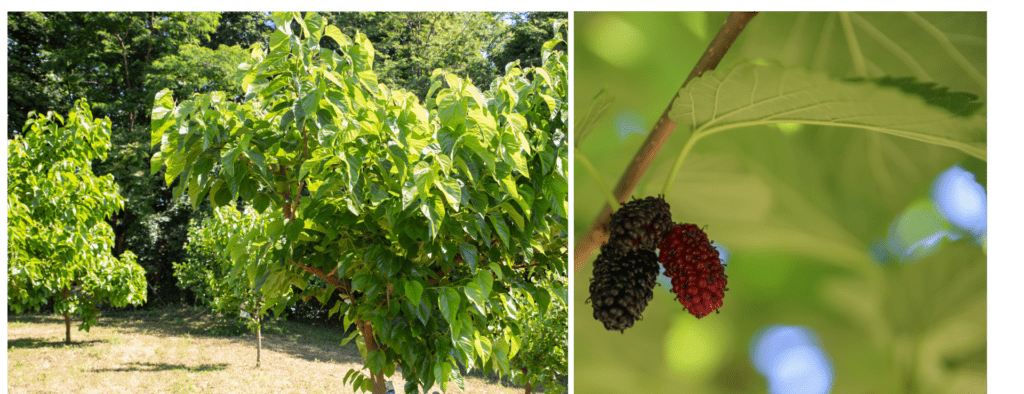
Origin and distribution. Morus indica is of particular relevance, because many key sericultural cultivars are related to this taxon. It originates from India, with many indigenous and monumental trees associated with the Himalayan region, where it occurs along mountain slopes and valleys up to approximately 2,200 m a.s.l. across the Himalayan belt. The species is now introduced in Asia, Africa, Southern Europe and the United States.
Key morphological traits relevant to sericulture. In sericultural practice, M. indica is commonly associated with vigorous growth and large leaves and has contributed substantially to leaf yield and biomass traits through selection and hybridisation. Its morphological expression is strongly influenced by environment and management; therefore, cultivar-level identification based on leaf and phenology alone remains unreliable. Traditional variety-level names frequently associated with the M. indica complex include bombycis, latifolia, kagayamae and multicaulis, although their morphological delimitation and taxonomic treatments remain inconsistent among researchers. Leaves often show retuse to cordate bases, obtuse to acute apices with acuminate and frequently caudate tips, and margins ranging from serrate and biserrate to dentate. Buds are generally long and narrowly triangular, light grey to dark brown. Current-year shoots often appear in greenish to yellowish-brown colours. Infructescences are typically cylindrical, frequently asymmetric, reddish-black to black at maturity, with persistent stigmas.
Conservation value and potential. M. indica germplasm is valuable for maintaining and improving productivity across diverse environments. In Europe, it is represented mainly by introduced material conserved in germplasm collections, where it can contribute to resilient sericultural systems by widening the genetic base for the breeding process (hybridisation and selection). Variety identification is critical, as without genetic verification, accessions may be mislabelled, duplicated under different names, or unintentionally hybridised.
Morus nigra L. (black mulberry):
Ancient species revered by Greeks and Romans
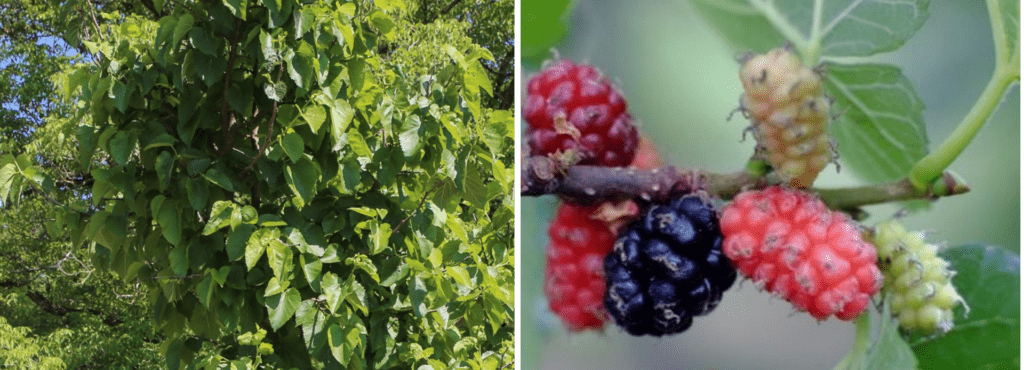
Origin and distribution. Morus nigra is accepted as native to western and southwestern Iran and has been cultivated for a very long time across numerous geographical areas, including parts of Europe, primarily for fruit and cultural value.
Key morphological traits relevant to sericulture. M. nigra can generally be separated from M. alba in the field by several vegetative characters. The crown is wider and thicker, and the trunk is twisted and knotted. Young shoots are strong, reddish brown and hairy. Compared to the white mulberry, the black mulberry has a uniformly hairy lower (abaxial) leaf surface. This gives the leaves a silvery shine. The upper leaf surface is dark green and rough. Leaves are broad, heart-shaped. Lobed leaves can also be present but are less common than in white mulberry. The inflorescence are generally unisexual catkins. The juicy fruits (soroses) are spherical, 1-3 cm long, greenish when unripe, gradually turning red and later dark black, and are very aromatic when fully ripe. This species is also characterised by extreme cytogenetic distinctiveness, e.g. very high chromosome number associated with polyploidy.
Conservation value and potential. Although Morus nigra was the first mulberry species associated with the establishment of sericulture in Europe and was later progressively replaced by M. alba, it is not considered a primary sericultural species today. One of the reasons for its more limited distribution is that the species is difficult to propagate by cuttings and grafting. Nevertheless, M. nigra remains a key component of Europe’s mulberry cultural landscape and is increasingly threatened by severe genetic erosion. Therefore, conserving M. nigra trees is of high priority.
Morus rubra L. (red mulberry): North American origin and European introduction with hybridisation implications
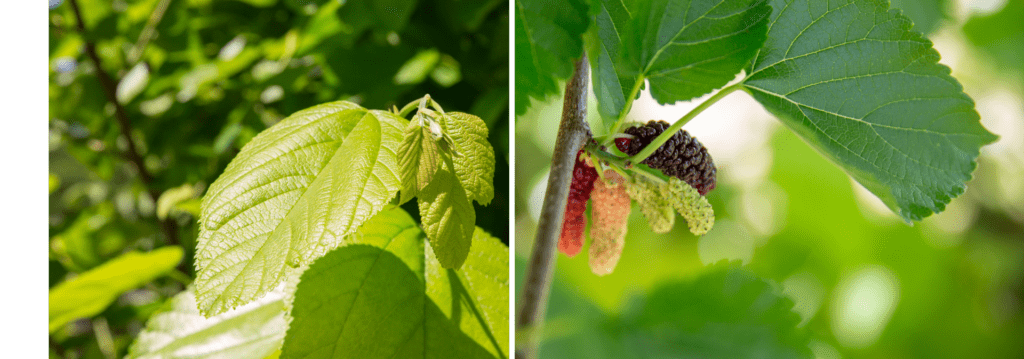
Origin and distribution. Morus rubra is accepted as native to southeastern Canada through the central and eastern United States and has been introduced elsewhere, with local occurrences outside its native range.
Key morphological traits relevant to sericulture. M. rubra is usually a small to medium-sized tree with leaves variable in shape and frequently unlobed to lobed. The adaxial lamina surface is relatively rough, with deep venation, whereas the abaxial surface may show variable pubescence. A key practical issue is its ability to hybridise with introduced M. alba, which complicates conservation and identification in areas where both species co-occur and reinforces the need for molecular verification when evaluating accessions.
Conservation value and potential. In Europe, M. rubra is an introduced species mainly valued for fruit. Its sericultural importance is generally secondary to M. alba and M. indica. Conservation strategies that include M. rubra should explicitly manage the risk of untracked hybridisation and ensure accurate identity assignment.
Conservation opportunities for sericultural use: why integrated characterisation is decisive
The mulberry genetic resources used in sericulture are predominantly clonal and maintained in ex situ germplasm collections, in situ/on-farm heritage trees, or as scattered and sometimes abandoned trees within former sericultural landscapes. This makes them vulnerable to pests, diseases, extreme weather, and discontinuities in long-term management. For sericulture, the priority is to secure and rationally utilise genotypes combining high leaf yield with local adaptation, while safeguarding heritage varieties that embody long-term historical selection. This requires a conservation model that (i) maintains varieties in ex situ gene banks, (ii) strengthens long-term security through backup methods such as cryopreservation, and (iii) documents and protects in situ/on-farm heritage trees that remain poorly inventoried. The value of these actions is maximised only when the identity and relationships among accessions are clarified.
Current genetic characterisation focus and the role of the catalogue in building a robust identification key
A persistent limitation in mulberry research is that morphological descriptors alone cannot fully resolve cultivar identity, because key morphological traits (leaf size parameters, lobed or unlobed leaves, leaf base, apex, tip and margin type, along with phenology, and reproductive structure traits) vary within a genotype across environments and management practices. To address this, the genetic characterisation of varieties maintained in the germplasm collections CREA (Italy), SCS Vratsa (Bulgaria), UM (University of Maribor), and IMIDA (Spain) is currently being explored, with the catalogue serving as the reference source for the most informative morphological and yield-related traits.
These traits will be combined in multivariate analyses together with molecular markers (Simple Sequence Repeat Markers, SSR) to (1) verify accession identity, (2) detect synonymy, (3) reveal taxonomic structure within and among the M. alba s.l. and M. indica s.l. ingroups, and (4) support the development of a practical, high-value morphological identification key. The intended outcome is a supportive determination key usable for germplasm curators and mulberry growers, while being scientifically robust because it integrates selected morphological descriptor combinations validated against SSR-based genetic evidence. This approach directly strengthens conservation for sericultural use by enabling improved selection of locally adapted, high-leaf yield varieties, ensuring true-to-type propagation, and safeguarding the remaining heritage gene pool as a strategic resource for future sericultural needs.