
History of the development of mulberry germplasm resources in Slovenia
SLOVENIA
The very long period of mulberry cultivation in Slovenia has led to the emergence of genotypes with different fruit characteristics through agronomic selection, as mulberries were mainly propagated by gamic propagation in the past, which increased diversity. Documented activities of mulberry genetic improvement in the form of mulberry grafting were not known in Slovenia at least until the end of the eighteenth century. The grafting of high-yielding varieties was more common in the warmer regions of Italy.
At the beginning of the nineteenth century, significant attempts in mulberry cultivation and selection were made by the Sericulture Station of Gorizia. The Gorizia Station was favoured by its direct connection to the Venetian sericulture. The rapid increase in the production of silk in Gorizia caused them to be serious competitors to the Viennese sericulture. Gorizia’s sericulture prospered, due to its natural advantages, although the companies did not benefit from loans, as did the Viennese ones.
When the Schools for Viticulture and Fruit Cultivation in Klosterneuburg and Maribor were established in the mid-nineteenth century, sericulture was taught both in theory and practice. Furthermore, in the middle of the nineteenth century, the Styrian Sericultural Society was founded, which provided practical courses for farmers. Furthermore, the society established a large mulberry nursery in Graz and began to supply Lower Styria and Carniola with lots of mulberry trees.
The history of mulberry cultivation and selection in Lower Styria is intricately connected with the fascinating agricultural rise in production of horticultural plants of the Novo Celje mansion, known as Styrian Eden, which was significantly promoted by Archduke John of Meran (1782−1859, brother to the Austro-Hungarian emperor Francis II). In 1843, the owner embarked on a remarkable endeavour by planting an initial 13,000 mulberry trees at the Plevna mansion. The favourable conditions and robust growth of the existing plantations prompted the addition of another 10,000 trees. Dr. Anton Perinello contributed to the plantation's diversity by acquiring mulberry trees of semi-low and medium cutting form from Lombardy and Rome.
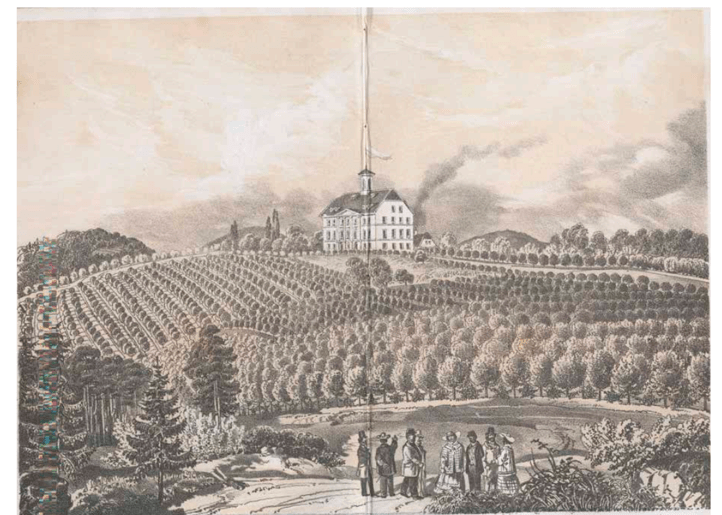
The entire plantation at Novo Celje comprised ten large plantations, with five adhering to the Italian model. Notably, all medium- and high- cutting forms of Italian mulberry trees were grafted above the root crown, demonstrating advanced horticultural techniques. These trees were mainly of the ‘Giazzola’ variety, followed by ‘Filippine’ variety, renowned, at that time, for their exceptional leaf yield and quality (Zimmermann, 2016). The Venetian-style plantations known as 'La Piantata Veneta' were thoughtfully arranged to ensure protection from winds and ample sunlight. Straight rows featured alternating mulberry trees in semi-low and high cutting form, accompanied by high-quality vine varieties, including ‘Burgundian’ and ‘Moselle’ (Figure 1, Figure 2). This systematic approach ensured a balance between high and semi-low formed trees and a harmonious integration of vines .
The success of Novo Celje's sericulture project was highlighted by the expert Antonio de Marco Paolino, who marvelled at the lush growth and bright foliage of the mulberry trees and vines. He attributed this success to the favourable location, thorough tillage, generous fertilization, the quality of trees, and protective measures against harsh winters.
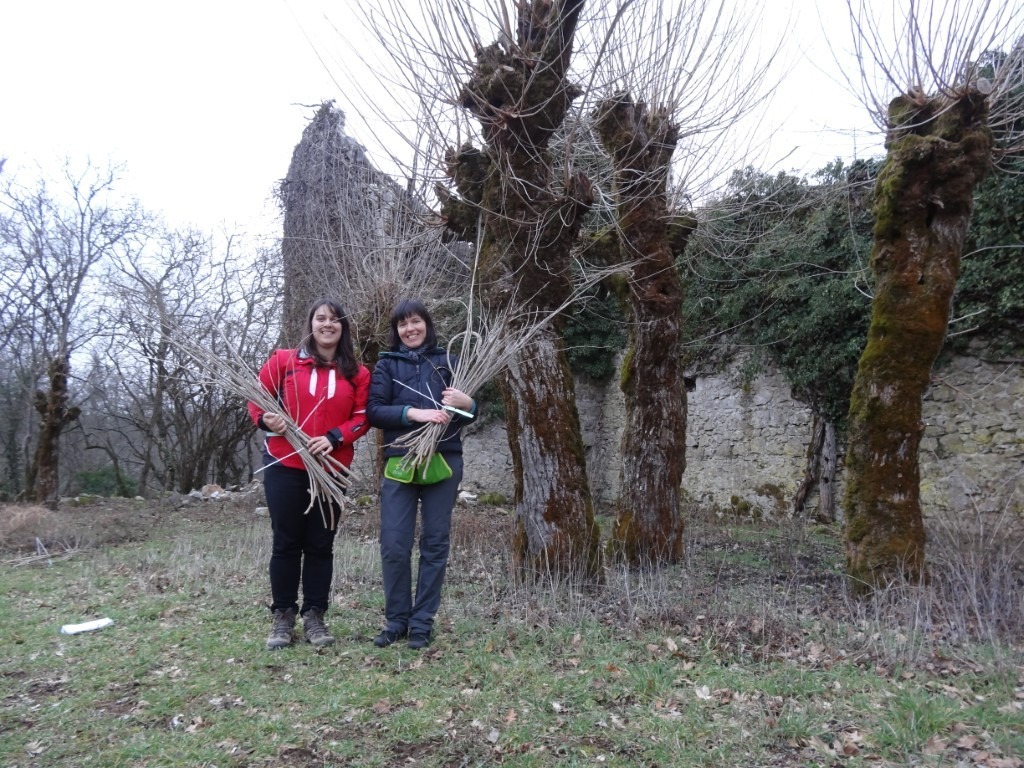
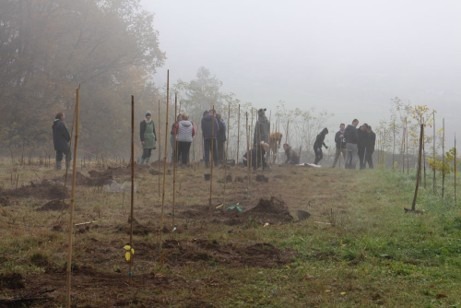
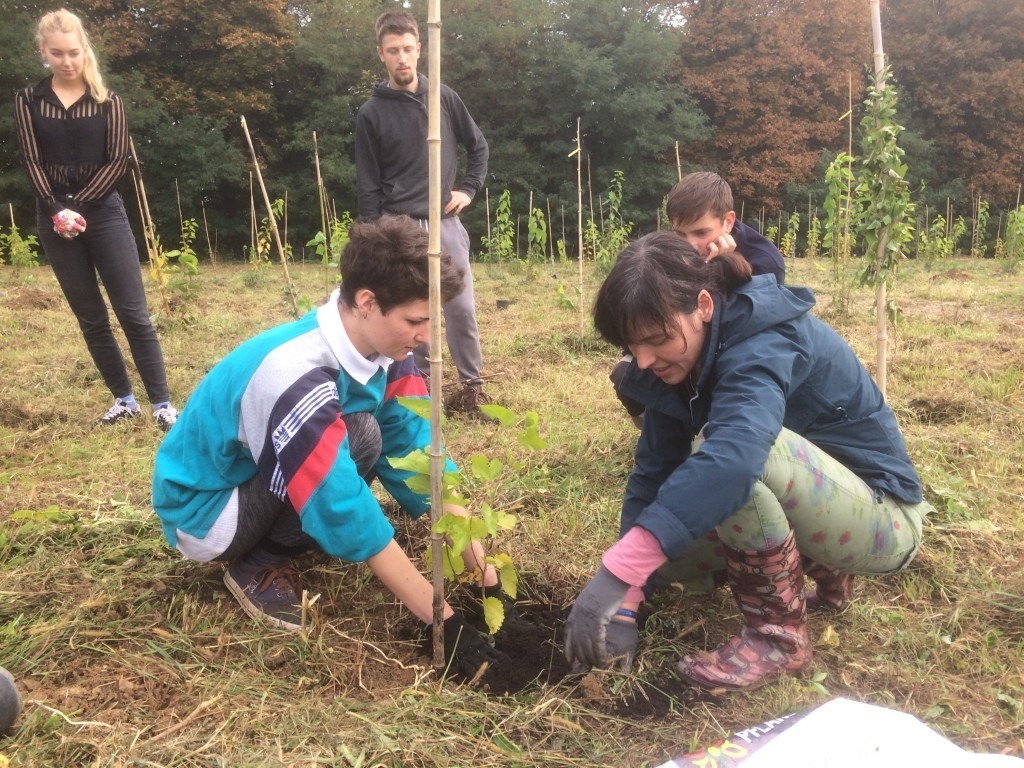
Figures: The Plevna mansion surrounded by a Venetian-style mulberry–vine planting system (“La Piantata Veneta”) in mid-19th century (Zimmermann, 2016). 2) Scheme of mulberry plantation design and tree arrangement at the Novo Celje mansion in mid-19th century (Zimmermann, 2016). 3) Second season (2016) of mulberry planting at the UM collection, including local varieties inventoried across different Slovenian regions. 4) Student-assisted work in the collection in season 2018.
The success of Novo Celje's sericulture project was highlighted by the expert Antonio de Marco Paolino, who marvelled at the lush growth and bright foliage of the mulberry trees and vines. He attributed this success to the favourable location, thorough tillage, generous fertilization, the quality of trees, and protective measures against harsh winters.
Figures: The Plevna mansion surrounded by a Venetian-style mulberry–vine planting system (“La Piantata Veneta”) in mid-19th century (Zimmermann, 2016). 2) Scheme of mulberry plantation design and tree arrangement at the Novo Celje mansion in mid-19th century (Zimmermann, 2016). 3) Second season (2016) of mulberry planting at the UM collection, including local varieties inventoried across different Slovenian regions. 4) Student-assisted work in the collection in season 2018.
In the spring of 1845, Novo Celje expanded their plantations to the Turnišče mansion at Ptuj, by importing 2,000 mulberry trees from Rome using Perinell's method. The plantation at the Turnišče mansion, thereby, signified a continued commitment to the further development of sericulture.
In 1896, Ivan Bolle's book ‘Teachings about moriculture (Murvoreja)’ provided valuable insights into mulberry cultivation in Slovenia. Since in the 19th century the rural population was predominant, arable land was of great importance; therefore, the mulberry represented a valuable advantage for farmers, due to its adaptability to peripheral areas, roadsides, field edges and less fertile areas. Bolle recommended planting mulberries in 1.3-meter-wide pits and taking soil quality into account. Fertilisers were utilized to promote robust growth.
The need for grafting arose due to the limitations of wild mulberries, which had small and lobed leaves less suitable for silkworms as they matured. Unfortunately, specific variety names were lost in history, and only the most silkworm-friendly varieties prevailed (Bolle, 1896). Mulberries were pruned in a manner similar to the Friulian approach, creating a multi-branched vase pruning shape that allowed light and air to penetrate, and made it easier to collect the leaves. The three-year pruning process aimed at obtaining a uniform branch size, a horizontal crown, and maximum leaf production with fewer fruits. Pruning also promoted the accelerated growth and sustainability of the trees. The primary goals of pruning were to maintain a horizontal canopy, prioritise high-quality foliage over fruit production, and promote tree growth and longevity.
Sericulture and the cultivation of mulberry trees experienced a significant decline after World War II, with no sericultural activities practiced for 70 years. Historical collections from the Sericulture Station of Gorizia, the plantations of Novo Celje, Plevno and Turnišče did not survive this period. The revival of sericulture began with the joint Hungarian-Slovenian Research Project (N1-0041) in 2015 and the establishment of a mulberry germplasm collection at the Faculty of Agriculture and Life Sciences, University of Maribor. This research institution, tracing its roots back to the School of Viticulture founded by Archduke John in 1822, had incorporated sericulture into its curriculum since 1870, aiming to integrate sericultural theory and practice into the study programme. Initially located in the town centre, the original school site was later repurposed by the agricultural institute, with its garden being replaced by fruit trees.
The mulberry germplasm collection at the University of Maribor was established in 2015 and spans 0.6 hectares. It is divided into three main sections. The first section maintains traditional sericultural mulberry varieties sourced from the germplasm collections of the Sericulture Laboratory CREA Padua and SCS Vratsa, including varieties such as ‘Florio’, ‘Morettiana’, ‘Kokusou 20’, ‘Kokusou 21’, ‘Kokusou 60’, ‘Giazzola’, ‘Muki’, ‘Restelli’, ‘Kiuryu’, and ‘No 25’. The second section comprises vegetatively-propagated trees from local historical Slovenian and Hungarian specimens, collected during a detailed inventory of the mulberry gene pool from 2015 to 2018 as part of the joint research project. This effort aimed to reconstruct and preserve the genetic heritage of ancient mulberry trees, by selection of local varieties optimally adapted to the region's pedoclimatic conditions and available to farmers. The third section of the collection focuses on species and hybrids primarily cultivated for fruit production, originally aimed at preserving varieties from all major Morus species suitable for the geographic region.